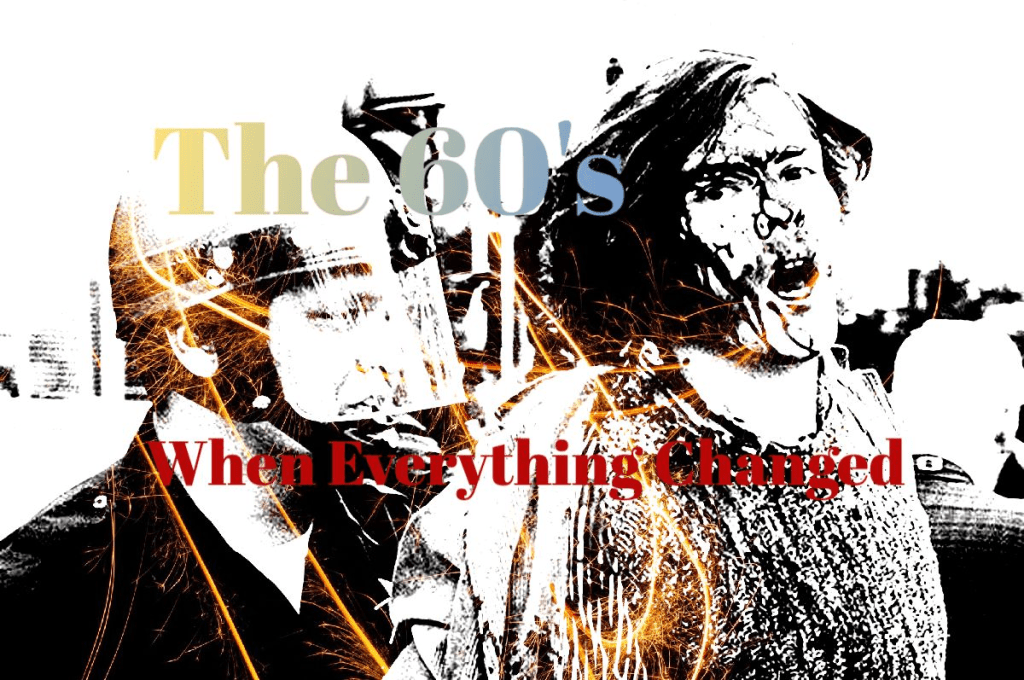
The 60’s exploded into view, something few would have been able to anticipate. Forces were unleashed that would change everything. Baby Boomers, now a majority and coming of age, found their voice and reached out for their power. It would unnerve our parents and rattle all the trusted conventions of the time. Even as I was living through it I could feel that everything I knew, all that I trusted was shifting beneath me. I just didn’t know how and I didn’t know my place in all of it.
I was born conspicuously white. And I would always remain so. I’m not saying that to be churlish nor to raise hackles. I say it neither to be contrary nor controversial and certainly not to announce embedded racism, an awareness that would be essential in the decades ahead. It is not intended as a battle cry, nor as some declaration of my sovereignty, I am saying it because it matters. It is what I am, and acknowledging that at the very least gives me a starting point. I was about to be thrown into the boiling social cauldron of the 1960’s. Unstoppable forces of change were about to collide. Knowing what I am and where I came from has helped me find my way.
We all have primary filters through which our experiences pass; being a white English male was mine. For another it might be being born black, or female, or gay. Understanding and acknowledging what that primary filter is has been instructive for me as I have tried to understand my life’s journey.
That awareness has allowed me to make sense of so much that was confusing. To me would flow power, authority, influence and wealth, such being the assumptive birthright of a bright, young upwardly mobile middle class white boy. But unbeknownst to me, that world was about to change and not at a manageable ‘plenty of time to adjust on the fly’ pace. No, so much of what was about to happen would be dramatic and urgent, giving little time for anyone to see it coming, certainly not me. Overnight, it seemed the battle was on. And for a young immigrant boy that posed a problem.
If I couldn’t see it coming how could I possibly prepare? Where would my place be in all of it? I did not know. I just knew I would have to find my place and to do that I would have to dance as fast as I could.
By the early 60’s I was well on my way to becoming Canadian, although at the time I couldn’t possibly have had a clue what that meant. Looking back from my seventy-one year old perch, I have never known a time that I didn’t love being Canadian. By every measure I hold dear, I love this country and have always understood how fortunate I am to have lived my life in it.
I didn’t return to Vernon Prep School for Grade 8. It might have been that my parents came to understand the school had fallen short of expectations, or perhaps my ‘Hoyme’ stories had horrified them, or more likely they simply couldn’t afford to send me back. In any event, in September of 1962 I found myself at KSS, Kelowna Secondary School. A better place for a full immersion into what it was to be Canadian, there could not have been.
The school offered Latin. Yes, Latin. It was of course a vestigial remnant from the colonial school curriculums of a time gone by but it gave me a grounding in language which has supported my love of words throughout my life. But KSS offered so much more.
Girls for example. And plenty of them, the perfect foil for a pubescent Tony. My problem was simple. I was twelve and in Grade 8. The girls were fourteen and in Grade 8, if you’re catching my drift. I can still see Patricia Miekle’s face as she struggled to find a way to say ‘No’ to me after I had asked her to the Halloween Dance. Poor Patricia had to look down at me, our heights being so out of sink as they were. How was I to know a fourteen year old girl would have had an eye on some sixteen year old boy and all the promise such would provide? It is just as well. I would have been devastated.
And then there was Cherry Shotton, a very pretty young girl, the daughter of my parents’ good friends. She played ‘Cinderella’ in the Christmas pantomime which my mother always directed. I was ‘Buttons’ the page boy, always rather uncomfortable in the tights the page boy was required to wear, compensated however with seeing Cherry every night for weeks at rehearsal. I fell hard.
And so did Cherry, for the sixteen year old Richard Long, ‘Prince Charming’ in the pantomime. Being so young it quickly became apparent was going to be a major stumbling block in my early love life. What could be done about that?
A nickname. Yes, a nickname would do the trick and I resolved to find one.
“George” I announced to no one in particular, and everyone in general. “From now on I would like to be called ‘George’. It is my nickname.” failing of course to honour the first rule of nicknames; one does not give oneself a nickname, they are bestowed upon you by friends.
Initially I was pleased with the early returns. The girls in my class giggled and pulled my leg and generally paid attention to me. This was going well indeed. But as with most things at that age, it got old in a New York minute and I was back where I had begun: a twelve year old boy in Grade 8, a fish out of water floundering around in a frustrating puddle of pre teenage confusion. How was I to know that this too would pass.
It did announce however, what would become a lifelong quest for a nickname, ending in ‘Homeless Fucking Bastard’ a moniker acquired when I was seventy, given to me by my new friends at the ‘10am Small Dog Dog Park Group’ in West Kelowna. That should hold you for now. I may tell you the whole story later.
The school years passed into summer and my life in Kelowna was really great. I took up hockey, outfitted as I was with old skates and magazines for shin guards, held in place by elastic bands, as they were.
Picking cherries in the Bruce-Smith’s orchard was my first job. Until it wasn’t. I had come home from a full day of picking cherries covered head to toe in big purple splotches, the unavoidable evidence of a day long cherry fight with my good friend Robert Arrance. His father, the foreman at the Bruce-Smith property, had caught us red handed; I mean literally red handed, not a part of us unmarked by the big juicy overripe cherries we had been joyfully hucking at one another all day.
“Go home Tony. Don’t come back tomorrow.” Mr. Arrance said matter of factly. I’m not even sure I understood I had just been fired.
On my long walk home, it dawned on me. My first job, my first day, my first firing. This was not going to go well at home. And it didn’t. My mother and father were furious. I was consigned to pulling weeds out of our rocky driveway for two weeks, a punishment worse than death for a freckle faced twelve year old boy in the hot summer of 1962.
But by any kid’s standard these were the greatest days of my childhood, a million memories from those times serving up delicious recollections to this day. How could any of us know that world was about to change?
I was a bit of a geek, of that there can be no doubt. I had joined the ‘Young Canadians History Club’ and received World History magazine once a week.
By twelve I could recite every world leader in every country, something which I was trotted out to do from time to time at my parents’ dinner parties. And I was an insatiable follower of the evening news, something I was allowed to watch each night. That is when I first watched ‘The CBS Evening News with Walter Cronkite’.
“Good evening. Tonight the world’s two greatest military powers and sworn enemies are on the verge of a global conflict. Earlier today US President John F. Kennedy ordered Soviet President Nikita Kruschev to withdraw all missiles from Cuba within forty-eight hours. He has ordered the US fleet to confront Soviet warships headed toward Cuba. The Russian ships are loaded with nuclear missiles.” It was October 1962.
If there had been any doubt, the events that would shake the decade were now officially underway. Just months before a US backed invasion of Cuba at what became known as the Bay of Pigs had ended in disaster, revealing for all the world to see its true colours; the United States was an interventionist foreign power willing in their ideological fight against communism to overthrow sovereign nations, a truth that has continued to this day. I didn’t understand it of course, that would take me decades but it sure had my attention.
I do remember being aware as the Cuban Missile Crisis unfolded each night on our black and white TV, that these two superpowers seemed prepared to engage in a terrible game of nuclear chicken, putting all that we had, all that the world knew into a nuclear jeopardy from which we might never recover. History has recorded that we came within minutes of such a holocaust. And as if to underscore my distrust of America and its military power it has just this year (2021) been revealed that in 1958 the American military recommended a nuclear war with China over that country’s claim for Taiwan. In the briefing paper to then President Eisenhower the generals acknowledged retaliatory nuclear attacks but calculated that as a civilian cost of doing the necessary thing.
It was only Eisenhower as President who said ‘No’ and put a stop to the planning, the same Eisenhower who warned at the end of his presidency in a speech to the American people, “Be aware of the military industrial complex.”. His warning has not been heeded. The US military industrial complex has essentially been in non stop global conflict for over sixty years, to date, fed by an annual budget closing in on $1,000,000,000,000 USD, a trillion dollars, more than the next ten nations combined.
That was my first brush with big questions, some of which remain unanswered to this day. Why is America so free to insist that their version of democracy and governance is the only one? Why are we so vulnerable to what they do? Doesn’t Canada have a voice in all this?
And I now know as well, it is where my lifelong distrust of America was seeded.
One school day, in November 1963 we were sent home early. Girls were crying, teachers seemed to be in shock. John F. Kennedy, the US President had been assassinated, beginning a decade of horrifying and frightening events, the overall impact of which would change me profoundly. Just recounting the most significant events reminds me of just how tumultuous it all was. And if it was unnerving for me just imagine how unsettling it must have been for our parents, a generation which had just fought and survived a world war, hoping no doubt for a return to the order they had known before it all happened. But a return to order was not in the cards. A return to disorder it would be.
1961 US invasion of Cuba at the Bay of Pigs
1962 The Cuban Missile Crisis
1963 JFK assassinated
1964 The Vietnam War ramps up
1964 Kent State, four students killed by the National Guard
1965 The first black student admitted to the University of Mississippi
1965 Selma civil rights march in Alabama
1965 The largest draft since the Korean War began in the US
1965 Millions of anti Vietnam war protesters in the streets
1965 Race riots in all major US cities
1968 MLK assassinated
1968 RFK assassinated
1968 Riots at the Democratic National Convention in Detroit
1969 The US has committed over 500,000 troops in Vietnam
And my list is incomplete.
Each night on TV images of race riots, widespread arson, cities in flames, police brutality against anti war protesters and civil rights protesters played out. Walter Cronkite would begin the CBS Nightly News with a body count of young American boys who had died in Vietnam, sent over to fight communism. He would end that count at over 65,000 American dead in 1974, after the Vietcong had soundly defeated ‘the greatest military power in all of history’. The US left the decade defeated and divided. And the worst was yet to come.
I have only laterally come to understand how much the war in Vietnam radicalized me. The indiscriminate and intentional bombing of helpless civilian populations, immolating helpless villagers with napalm, all part of trying to break the spirit of the Vietcong, the communist enemy; counting hundreds of thousands of dead and injured Vietnamese civilians as simply the cost of war. President Nixon and the Secretary of State Henry Kissinger looking through the TV screen and lying! Denying to the American people that they were attacking Cambodia, at the very moment bombs were raining down. And for what!!? To fight communism they were told, a political force which would destroy all things “held sacred by the American people”. It was an evil fallacy, a hollow justification then, as it remains today. The worst of it all, through the rest of my life I have witnessed as the US government has continued this imperial behaviour, keeping their civilian population on a war footing, serving a vile intoxicating gruel of nationalism, patriotism and militarism through each successive decade.
Go to any sports event in the U.S. and watch as a colour guard or the military are honoured. Watch as fighters and bombers fly over the stadium. It is all intentional. And each time that country decides on another enemy they trot out the same powerful propaganda machine to ensure public support. Consider that this year (2021) the disclosed U.S. defence budget was $760B US, more than the next ten nations combined, including China and Russia. Dark money unaccounted for in any public record pushes this annual budget past a trillions dollars. I have adjudicated that America is a dangerous country, too powerful to ignore, but for all of that power, too cancered to be trusted to do the right thing.
I’m sure this seems like an angry diatribe from an old man and I suppose it is, perhaps as some measure of frustration. You might think it all sounds a little old, history from long ago. But that is the point of history. It reveals ourselves to ourselves; where we have come from is where we are going. As that is true of us as individuals so is it true of countries. So be your own judge. As sure as I am writing this today your turn to decide will come. Be careful is all I ask. It is not my place to tell you what to think, I mean only to persuade you to think for yourselves as individuals and as Canadians. We are different, we are not Americans, nor can we simply align with that country because we feel beholden. Nothing could put us in more peril.
Looking back I know now that for my generation the ‘60’s served a purpose. Through all of the conflict emerged the issues of our time and gave us a generational opportunity to identify the issues we would take on as ours. Not of course, with unanimous chorus, opinions will always differ but as they emerged they became crystal clear. What side you were on would, for many remain undecided but undeniably these were the issues of our time. For me, the war in Vietnam, civil rights and racism, the US government and its foreign policy, and the women’s movement would bring into sharp focus the path ahead.
In 1963 Betty Friedan published The Feminine Mystique, challenging the basic tenet of social structure, that a woman was fulfilled as a housewife and mother, and that to be feminine was to have no need to work, get an education or have political opinions. By the late 60’s Gloria Steinhem emerged as an activist leader of the women’s movement, famously writing, “a woman without a man is like a fish without a bicycle” striking a chord with millions of young women across North America, galvanizing the forces of structural and cultural resistance and change. Her book ‘After Black Power, Women’s Liberation’ terrified the establishment with the rhetoric of revolution.
Many had come before and many after, and there will be more yet but as leaders emerge for each generation they serve to remind their followers that there is work yet to be done. As have Maya Anjelou and Malala Yousafzai since in their time, Friedan and Steinhem sparked fundamental social change which is still evolving as I write. There is always more to be done. Others will follow.
Now let me be clear, young Tony was not a feminist in his teenage years. How could he have been? Born into a rigid conservative family, immersed in the gender roles of a postwar middle class family, I had absolutely no frame of reference. In some ways that has been interesting. How did I start there as a young social conservative and end up where I am, an outspoken liberal progressive, the proud father of four children all of whom were raised as feminists, male or female, it made no difference.
It would take some dancing.
The dinner table at our house in Victoria was a place for delicious family meals and vigorous conversations. Intentionally so. My parents both wanted to cultivate our ability to discuss, argue, have an opinion and defend it without losing our temper. I know now it was invaluable although at the time I would lose my temper and be told off. Of course they argued their side but they didn’t require me to agree with them, that was not their goal. My parents were teaching me how to think, clearly and under pressure. It was yet another gift I would only later come to value.
We had moved to Victoria in 1964 and I was enrolled in what was then University School for Boys, later becoming St. Michael’s (SMU). It was great, all the world around might be embroiled in some sort of mayhem, but my high school world was structured and peaceful. I would just get on with it.
I’ve always done my best in a structured, goal oriented environment and University School was all of that. I thrived; in my final year I was a school prefect, the loose head prop on our 1st XV, on the cricket XI, the badminton team, tennis team and cross country team. I was Cadet Major Tony Peyton, the senior officer in the school regiment. There are photos of me presenting the regiment in full parade to Brigadier Angle, ramrod straight in full dress uniform, my boots mirror polished. I was 16 and I was my father.
I do remember three of my American classmates in the Grad Class of ‘67. Jim Wilkerson, John Middleton and Chance McKenzie, were all American boys who had been sent to private school in Canada. They had talked openly about the draft they were facing when they returned home but said they wanted to go to Vietnam. With the overstated bravado of young American boys they would announce to no one in particular that they wanted to go over there and show those Vietcong gooks just what US military power was all about. “Besides, if we don’t go, the Commies are going to take over the world.”.
Within a few months of graduation, my three classmates had died in Vietnam. Just six months earlier I had celebrated winning the private school rugby championships with them. Once upon a time they had been teammates. Now they were dead.
I was angry and it led to a bitter fight at the dinner table with my father, “I won’t have any son of mine presume to tell me what the American government should or should not do in Vietnam. You’re sounding like a bloody communist!” But now I wouldn’t back down. I was seventeen and angry, now fuelled by the emotions that come with knowing real people who had died in Vietnam. For dad it was a matter of principle. For me it was as well. Just different principles.
I had cut to the quick all that my father held dear. “King, country and family and in that order” he would say. For a son to challenge that basic tenet would never be tolerated. For me, it was less complicated. It was my coming out party. I had found my voice.
I would never again trust the US government. And that country has given me no reason to reconsider that distrust since; through each and every decade bullying the world with its raw power, threatening our security and arbitrating right and wrong without debate. That war revealed to me what America is at heart. A country bitterly divided by racial hatred, and profound wide ranging inequality. Choose your poison: voting rights, civil rights, gender equality, income inequality, lack of basic affordable health care, a weaponized population, militarized police, incredible wealth just down the street from abject poverty, standing militias sworn to overthrown their government and a dysfunctional government, riven by unbending populist nativism and ideological division.
Through this lens, the 60’s it seems to me, had the greatest impact of any decade that came after. I was young and impressionable, inquisitive and searching, all things encouraged by my schooling and my parents. I have filtered most subsequent experiences through the impressions left by that decade. Right or wrong I’ll leave to you, I just think you need to understand that context if you are to make any sense of my ramblings.
And let me be clear though for those of you who may now think I am dismissive of my parents and what they believed in. Nothing could be further from the truth. Disagreeing with them is missing the point, of course I did, the next generation most often does. As I did, so have my children and so too will yours. What my parents gave me by the time I was ready for the next step was an active, thinking, challenging mind. I am sure they would have preferred my politics to be more aligned with theirs but that is not what they required of me. They set out to ensure that I could think for myself. In that, they succeeded.
I was ready to dance. And off to the University of Victoria I went.
**Note: On the stroke of my 16th birthday I applied for my Canadian citizenship, the first date I didn’t need my parents to sign for me. I couldn’t wait. Eight years in this magnificent country had revealed everything I needed to know. I arrived English in 1958 but I will die Canadian, of that I would make certain.


 Tony with a capital T
Leave a reply to Shawn Talbot Cancel reply