Sometimes I just didn’t get it.
How could I? I wasn’t awake yet.
All important change happens over time. A long time. I know now that I was born into a time of great change in the women’s movement and that it would have left many in my parent’s generation unsettled, the sure footing from generations before going through tectonic upheaval. I was witness to that and believe I aligned myself progressively with the change that followed. The shift in status, role, authority and influence of women was real and certainly affected my path but it was made easier for me because I at least could see it coming.
By the time I was involved in that generational shift, I had been living in my social and cultural setting for twenty years. I had witnessed first hand the uneven power structure within my own family let alone Canadian society generally.
The decision to emigrate had been driven mostly by my father. Even for things as mundane as running the household my mother was given a monthly budget by my father; when mum ran over at Christmas she would have to ask dad for more money and explain why she needed it. I can remember a furious fight one evening early in our years in Kelowna when my father ordered mum to change out of what she was wearing to a party. We didn’t have a lot of money but my mother was always beautifully dressed and that evening she had worn a brand new fashion of the day, the muumuu. The Hawiian inspired fashion was ideal for hot summers in Kelowna, bright and colourful and loose to the body. I knew she was excited to wear it out for the first time. Dad did not approve and ordered her to change. She did.
Mum was a very good actress having won a placement at RADA, the English equivalent of Juiliard. Who knows what her path would have been had the war not intervened. In Kelowna, she took a leading role in theatre productions either acting in lead roles or directing. It was a very happy place for her but a source of great friction at home. Dinner was to be served at six sharp and my mother was expected to be home at night with her husband. As preparation for each play intensified prior to the performance week the demands on mum’s time grew and it all led to thick tension in our house. Even as a young boy I hated it. I was close to mum and could feel her silent pain. She was English so would never display how hurt she was in front of her children but I can remember her muffled crying in their bedroom. And that was the way of our household throughout my life.
I’m recounting all this because it describes anecdotally my little mushroom patch, where I came from. It may help some understand my path here. It is where I came from and the backdrop against which my life played out. I think as well, when I was inevitably confronted by the protest energy of the women’s movement, I wasn’t by that time a hard sell. Without explanation it made sense to me. Had I been born female into that time I would have protested as well. Without being told I understood it was unfair. That for me was the backdrop against which the feminist movement played out. Without having to think too much, it made sense and was the cultural experience I had witnessed when it came my time to learn more and choose my allegiance on the issue.
Turns out being woke is easy when you have been ‘awake’ for some time.
That said, on at least one other major issue of our time I was sound asleep.
If I was to be woke on issues of systemic racism in the US and Canada I would have to wake up first. When I said earlier that I was born conspicuously white, this is in part what I was referring to.
There is absolutely nothing in my background, in my lived experience which would have helped me to understand, to have any insight into the life of a person of colour whether black, brown, Asian or indigenous. If anything, the echo from my early years is heavy with praise for colonial Great Britain, everyday conversation in my home laced with assumptions of white racial superiority. It is why I know how insidious racism can be; it is difficult to see when it lurks at the dinner table of an otherwise good and decent family. Racism had a seat at my family table. I was never told that we were superior to others, it was an assumption. In my early years I had no reason to think otherwise; I knew nothing and without knowledge I could not easily awaken nor understand what role I could play, if any.
And again not to insight anger but rather to shine a light on where it is I came from I will tell you some stories from those early years. It was not uncommon in my home to hear my father say with the uncompromising anger of a man who had fought an enemy and survived, “The only good Jap is a dead Jap.” And who was going to tell him off? He had gone to war at eighteen and survived, no doubt taking terrible memories to his grave. Who was I to tell him off?
My parents would say out loud, “Well of course mulatto’s have beautiful children, don’t they?” It was a polite, racist nod to interracial marriage which was frowned upon, as weakening the blood line. And it was all said without affectation not intended as a racial insult, it was just the way things were, a statement of fact. That was the English way.
“You know they are very good dancers”, echoes through the decades, something my father would say when describing black men “and very good athletes”, all of it with its undercurrent of sexual virility that black men represented to white women and not coincidentally, the unstated threat they represented to their husbands.
Even my favourite marmalade, Robertson’s, had little black golliwog characters frolicking happily on the label. I was just a ten year old boy who loved Robertson’s Marmalade, I didn’t know what I didn’t know. Much has changed of course but it has been glacially slow. In 2021 Aunt Jemima, a black antebellum image was finally removed from pancake box covers. Other overt examples of America’s racist history remain in full view.
Racism is embedded in people of all ethnicities, race and faith of course. It is not just the generational heritage of white people. History confirms all people are racist, most often developed over time as a defence against change and as a battlement from which we protect what we perceive to be our culture, authority and power. But the racism of my time would become clear to me.
As observant of my world as I was by my early twenties, I could only engage in things I could see. I could see women, I could see the environment but I could not see homosexuals and I could not see racism. And I couldn’t be expected to ‘see’ until I woke up and I couldn’t wake up until I could see! That is in a way how racism, our own racism and systemic racism survives unchallenged and why it is so sinister. It hides in plain view, unseen by otherwise decent people. In both Canada and the US generations of white people had compartmentalized racial divides, intentionally.
Vestigial examples remain everywhere; in the ‘Chinatowns’ of our cities for example. What is often now regarded as a cultural experience often viewed through a culinary filter was once simply where we forced Chinese immigrants to live, so that they would not live among us. In our own country we codified racism with the Indian Act creating reservations in which ‘they’ would live.
In my beautiful Deep Bay summer sanctuary, nestled on the eastern shore of Vancouver Island, racism thrives, as it does everywhere. The camp has about one hundred permanent summer residents, many of whom have been coming for generations. They are good people, at the reward end of their lives, having worked for decades and raised their families. Peels of laughter echo each day as families gather where ‘Schitt’s Creek meets a seniors home’. From time to time Asian families arrive for a few days of camping, many of them coming year after year as a traditional rhythm to their year.
“They’re back” one friend said to me.
“Who’s back?” I had no idea who he was referring to.
“You know those Japanese, or Filipinos, they come every year. And all they do is harvest oysters, all day long. And they don’t have licences you know.”
And there it was. The worst kind of racism. Insidious and deniable, coming from an otherwise decent person, one who had spent a lifetime teaching good values to his own children. He was a safe haven for his racism. These Japanese, or Filipino people were for him nameless, a category of people he lumped together as ‘they’ and ‘them’. And to confront him as racist would have been greeted with denial and claims of insult. I would never name him, to do so misses the point. He is us. We all offer safe harbour to racism. It is unintentional, unwitting and for the most part unseen. That is what makes it so sinister. We can’t change, what we can’t see. And we can’t see until we wake up. It’s an issue.
In the US the black experience has always been and remains to this day repressive. There are of course positive examples of change latched upon by those who reject any suggestion of systemic racism as proof to the contrary, citing among other things the presidency of Barack Obama, the first black president and the vice presidency of Kamala Harris, in the current Biden presidency, a woman of black Asian heritage.
Those images continue however to be backlit by the fires of widespread racial protest in American cities and black men being shot dead by police in shocking numbers. To this day black teenage boys are given what is called The Talk by their parents, a stark cultural warning to remind them of the unequal place that is their reality in American society.
In 2021 the state of Georgia passed widespread voting rights restrictions, after black voters in Georgia dared to vote en masse and elect two US senators from Georgia, a shocking example to the white establishment of the rising power of black political power. It was an uppity affront to all that had come before. It is now illegal in 2021, to give water to voters waiting in long lines under the hot Georgia sun. Polls will now close at 5pm ensuring that hundreds of thousands of black workers are effectively disenfranchised.
After the Civil War in the States, anti slavery democrats established comprehensive rules, laws and regulations to ensure that freed blacks would be held in place, given little opportunity to rise in their station. Those Jim Crow laws began in 1870, and continue to this day, one hundred and fifty years later, not by title but still with insidious purpose. The only difference now is that it is called by a different name. Now they call voter laws intending to suppress black political power names like a Law to Protect the Integrity of Voting Rights.
I was witness to the savage racial battle that played out in the 60’s, safe as I was behind our black and white TV screen. Race riots in that decade lit the night sky in every American city. Disproportionately young black men were drafted and sent to Vietnam to fight America’s war against communism. Police brutality against blacks played out nightly on the CBS Evening News with images of blacks being targeted by police as fire hoses and truncheons rained down on civil protest, police dogs unleashed on the marchers. Alabama Governor George Wallace ordered his national guard to shoot black students if they tried to enter the university. Martin Luther King Jr. gave his ‘I have a dream’ speech in 1963 before hundreds of thousands at the Lincoln Memorial during the March on Washington. He was assassinated in 1968. Mayor Richard Daley unleashed the full fury of white America on black and white protesters at the Democratic National Convention. And for the most part white America stood silent sentinel, President Nixon’s ‘silent majority’ giving essential political support throughout the turmoil, more interested in prosecuting a war they would lose than addressing racial divide. ‘These blacks need to be kept in place’ was conveniently hidden in Nixon’s ‘law and order’ mantra. What white suburban voters of the time would disagree with that?!
To this day, it is a racial divide which continues to cleave America, arguably a racial divide as deep as it was during the Civil War. We have just witnessed the raw rhetoric of the Trump presidency, underscoring this racial divide for political purposes when the opportunity arose, comfortably embracing elements of White Nationalism. Blacks continue to protest on the streets galvanized by what was once called Black Power now morphing into BLM, Black Lives Matter. It is a movement arising from the continuing horror of police brutality and violence against blacks, outraging urban populations after the continued cold blooded killing of so many black men by police.
Of course it is a headline, the ‘black protest headline’ which has travelled through history to this moment in time and I expect will travel further down the road. Since the Civil War and Jim Crow there have been over 4,800 public lynchings in the US, the vast majority black men; this fear, this racial hatred continues today and is an unhealed wound which will keep that country with its great potential from achieving it. For the most part Americans can’t ‘see’ it for what it is, to do so would confront their foundational premise of American Exceptionalism. If you can’t ‘see’, you can’t wake up and if you can’t wake up, you can’t change a thing.
In Canada we have our own reckoning to complete. Post colonial Canada was constructed on the blueprint of imperial success which among other things required that the society be divided along racial lines. Our indigenous population became the most obvious example of that. We took their land and forced them onto reservations. We took their religion and assigned the Church to impose our Christian heritage on them. We took their culture and consigned it to history. We were deaf to their music and blind to their art in an attempt to bury it away.
We even took their children and sent them to residential schools, many of whom never returned home. As I write (May 2022) there are 4,100 documented cases of missing indigenous children. The remains of 215 indigenous children have been discovered on the grounds of the Kamloops Residential School, one of over 130 residential schools administered by the Roman Catholic Church established in Canada to assimilate native children into our ‘Christian’ world. Another 752 children have been found in unmarked graves near a residential school in Saskatchewan and 172 in Cranbrook, BC behind a former residential school. Imagine that, we removed those children from their families and forced them into these residential schools and when they died, they disappeared, without record or explanation. For the most part parents were never notified. Inevitably there will be more children found. It is a despicable blight on our historical record and yet horrifying truths aside, it is still not uncommon to hear good people express resentment and anger about government support for our Indigenous populations,
“We’re giving them everything. What more do they want!?”
For just a moment, just one moment imagine how that must be heard. We took their land. We took their art, their music, their language, we took their culture. We took their family. We destroyed their communities and their way of life. We took their freedom to roam. We took their lives with smallpox and measles and we wiped out entire indigenous populations in the process. We took their children for God’s Sake! We took everything. We were wrong and now it is time for a reckoning. Learn the truth, teach the truth to our children and find some mechanism to compensate for what we have done. This is ours to reckon with.
To our credit Canadians are turning to the task. Where calls for ‘Reparations’ for blacks are met with deaf ears in the US, Canadian courts, politicians and a majority of everyday Canadians are aligned and moving ever so slowly toward a reconciliation. It will cost money and land and sovereign wealth and lead to social, cultural and economic upheaval but it is for me, an historic turn, a long time in the making and a good thing for our country. I have not played any material part in this change, more observer than participant and for all practical purposes I’m kind of running out of time. This racial inequality, woven tight as it is with wage and economic inequality will continue to blight the social and cultural landscape of the times ahead unless it is confronted and changed. Fact is while I may have woken up late to this issue, the real and permanent change is left to the next generation and those to follow.
There are now calls to abandon Canada Day celebrations going forward, suggesting that it is a nod to the colonialism of our past and connected to the cultural genocide with which we are just now coming to grips. Widespread anger is being reflected in daily news about Roman Catholic churches on band lands being torched and various statues of Queen Victoria, Queen Elizabeth and others being destroyed by protesters. The fury is understandable and it is true, colonial history underpinned our official government policy which established residential schools but I don’t think we should abandon Canada Day.
Bringing me to Canada was one of the greatest gifts my parents ever gave me. It is a magnificent country. We are a country of values and need to confront this terrible history but that is what it is to be Canadian. As it is of us as individuals, Canada will always be a work in progress. In 2015 the Canadian Truth and Reconciliation Commission issued its report, seven years in the making. The Truth report concluded that the Canadian government and churches pursued a policy of “cultural genocide”, one of the most significant impacts being the establishment of residential schools and forcible removal of children from their homes, all of it as official government policy to assimilate indigenous populations in our country. For the most part the recommendations in the Truth report have not been acted upon; it can provide a framework for the work ahead. We are a fair and decent people and I trust that we will, over the decades ahead, hold ourselves to account and reconcile with First Nations , Metis and Inuit indigenous peoples. If not now, when?
As a postscript to this story I want to acknowledge my son Jono and the work he is involved in as a thought leader for this renewed Canada. He was one of the principal contributors to a Knowledge Network documentary series, ‘British Columbia: An Untold History’ (2021). I couldn’t have been prouder to watch Jono and his peers shed light on our history of racism. My buttons were popping! And where Jono is an obvious voice, no less important are our voices. What we say when we’re with our friends, or co-workers, what we say to our children, that is where we can be change agents, in places where we are respected as parents or peers. That is where we must do our work.
As I could not ‘see’ racism, I could not see homosexuals or lesbians either.
I do remember my father referring to gay men as ‘faggots’ in the crude vernacular of the day.
And I recall how my mother delighted in poking the beast when she would say, “Well you do know Jim, Hannibal was gay. Don’t you?”. Dad was a military historian and he regarded Hannibal as one of the greatest military strategists in history. I think mum just enjoyed needling him and his homophobia was a way in. Now if you have no idea who Hannibal was, and let’s face it, none of us do, let me shed some light. Hannibal was a Carthaginian general circa 180 BC, widely feted through history as a brilliant soldier who most famously led an army across the Alps from North Africa to campaign against the Roman Empire.
Not that any of this matters in this voyage of discovery but now you know. You might make it your party trick. But that was about it, in my house growing up, the passing vernacular insults the sum total of the obvious homophobia. I of course would have known gay men but none that had come out and I do think it wouldn’t have mattered to me had they done so.
And as with so many issues of my time the opening salvo in the gay rights movement was fired in the ‘60’s. The Stonewall riots of 1969 are often seen as as the turning point in the gay rights movement. Police raided Stonewall, a gay nightclub in Manhattan, arresting many men in the process, triggering several days of rioting. The media coverage of the New York press captures the attitude of the times.
The New York Daily News blared “Homo Nest Raided, Queen Bees are Stinging Mad” reporting that “Lilies of the valley pranced out on the street when the cops arrived.” Even the Village Voice, at the time a left wing underground paper, chimed in, “Police had trouble keeping a dyke in the patrol car” and “Faggots stopped dancing as police bust in the doors.” So that was in 1969. Of course, a lot has changed. A lot has not. In 2016, a man killed 49 people and wounded 53 others in a gay nightclub in Orlando, Florida.
Just this year, fifty some years later, the son of one of our good friends came out. He had been married for many years and was the father of two children with a third on its way. He came out to his wife and family just three months short of the birth of their third child. To say it was a shocking turn is to craft an epic understatement. The child was born in due course and the couple worked out a new balance in their lives. Three months after that child was born his wife posted a family photo with the new baby wrapped in a blanket of gay pride colours and the comment, “Families come in many shapes and sizes.”. I was stunned. It was an open and kind embrace of her husband as the gay father of her three children and of all things I have seen in recent years it underscored the incredible pace of change that has washed over our society in the fifty years or so since Stonewall. It was not easy, it never is and it began with the typical and shocking confrontation that often tips the spear of change. Open displays of flamboyant homosexuality were prominently displayed in national and local media. Violence against homosexuals was widespread. And as the AIDS epidemic took hold in the 70’s and 80’s conservative forces pushed an anti gay agenda at every level. Churches railed against the sin of homosexuality and it was illegal for a gay man to join the military.
I think as well that popular culture and the media played a critical role. In the 1980’s Norman Lear’s ‘Archie Bunker’ confronted the sexist, racial and homophobic stereotyping of the times. His TV characters were outsized versions of us and of our parents and he used sitcom humour ironically, making us laugh at ourselves although it would take time for us to understand that. ‘Klinger’ in MASH, the most popular TV show of the 70’s, tried endlessly and in vain to avoid military service as a cross dressing homosexual character. Later “Will and Grace” presented the principal male character as living a quintessentially normal life in every respect, adding in passing that he was gay.
Freddie Mercury of Queen and Elton John spent many years hiding their homosexuality from public view, although you just had to open your eyes to see them as gay men. Freddie died young with complications from AIDS but Elton John went on to eventually come out and play his role in the societal change in attitude. I am cherry picking of course, there are literally millions of examples to choose from but the short point is that each gesture times a million, times another million created an extraordinary momentum and appetite for change that just fifty years later must be unrecognizable for many born into the ‘60’s.
My wife Mac will remember me being sharply critical of those sitcoms and others that followed. I had no time for the caricatures of gay men as they were depicted, usually given some flamboyant flare by the screenwriter. I always thought it perpetuated the stereotyping of homosexuals and in so doing ‘approved’ the way they were treated. As often as not I would refuse to watch the shows at home. Archie Bunker in my world was not a lovable, old fashioned character, he was a despicable, vile example of what was so wrong, so unfair and he was able to hide all of his racism and sexism beneath a veil of humour.
I now realize Mac was on to something. I needed to lighten up. When pop culture turns its focus on social issues, humour can be used to strip the emperor bare, to reveal what lurks beneath the surface. Pop culture in the hands of people like Norman Lear can play a major role in social change. It is for me a singular example of how profound change can happen when an entire generation and those who follow put their shoulder into it. It helps us wake up.
What was once easily defined as a gay rights movement has now morphed into a complex multi layered conversation surrounding LGBTQ and gender identity, coming as these things always do with new vernacular and new vocabulary. I can’t say with integrity that I am woke to all the issues but I can say with integrity that I am making it my business to learn. That is my part of the bargain.
Through it all, my most influential role may have been as a parent and as such able to influence our four children, who have become in turn, the influencers of their time. That is as it should be.
Profound change often as not is born of political and social activism and the upheaval that comes with it but it must at some point land on the breakfast tables of ordinary people. I will never forget the day one of the children came home from elementary school with a schoolyard joke,
“Did you hear about the Indian …?”
I can’t recall which child it was but I do know they never did get to tell that joke. Mac stopped it abruptly,
“Not in our house honey. That’s not a joke.”
And there it was, landing on our breakfast nook, the influencer influencing. That’s when you know change is afoot. That is the activism we can all bring to our ‘breakfast nook’ whether it be with children, at work or with friends.
I too was reminded after a similar exchange with Mac,
“Hey did you hear about the blond car driver …”
I didn’t get to tell that joke either. Mac was right of course. She didn’t appoint herself ‘racism and sexism police’, it was the last thing she wanted to be. She has never seen herself as an agent of change, nor did she set out to be one. But it is through the ‘Mac’s’ of the world, the Mac’s of your time, when change becomes real. She was simply accepting her responsibility to be part of it and to influence others around her. She was simply helping us to wake up.
“Did you hear the one about the Chinese driver?”
Who among us, right?! It’s a starting point.
The battle is eventually played out where everyday people live. Around 2001, I travelled with one of the hockey dads to a tournament in Seattle. Toby was playing on the Quad A Midget Rep team. The boys were on the team bus. My friend asked rhetorically,
“So what do you think about this ‘Justin’ kid?”
“What do you mean?”.
“Well he’s a faggot. I don’t want my boys showering with a gay guy.”
I had to literally shake my head and check to see it was 2001. I couldn’t believe what I was hearing. In fact I had heard about ‘Fred’. Toby had let me know that the boy was having some mental health issues and was trying to figure out if he should come out. That he was gay didn’t matter to Toby, that he was having mental health issues did. He was awake. God Bless the next generation.
“Yeah I know.” I said, “I don’t care about it. I hear the kid has some huge anxiety going on.”
And the conversation ended. I really believe that is where the battle is won or lost, when the questions and the change reach down into the lives of ordinary people; two men like us travelling in an SUV to a hockey tournament in Seattle is where stuff happens. Where I can do my part.
Mac and I have visited Mexico for many years. In 2020 we were in Puerto Vallarta spending a day with Mac’s friend Lynn Paddon in the rooftop pool at her very swanky hotel. With an early morning cocktail in hand (don’t judge me) I swam up to some friendly looking folk.
“Hello, where are you guys from?” came the friendly reply and a fun conversation followed. Eventually one of the guys, a large funny guy said, “Hey I’ve got a joke. You’re gonna love it.”
“Sure” I said, “let’s hear it.”
“So there’s these two faggots …” and Mac jumped in.
“No, I’m sorry I don’t want to hear any homophobic jokes.” and she swam away from the group.
I was not at all surprised. Mac is gracious and non confrontational but stands up for what she thinks is important, in whatever form it arrives. That this homophobia came wrapped in a joke made no difference to Mac. My Minnesota friend on the other hand was a little nonplussed but I encouraged him to tell the joke. So he did.
It was a typical homophobic joke that may have still played well in northern Minnesota but not in my woke world in Kelowna.
“Frank, you need to be careful with jokes like that.” I prodded.
“Fuckin’ faggots, who cares about ‘em anyway?!”
“Well look here’s the deal Frank, we’re in Old Town in Puerto Vallarta. Decades ago PV made a decision to be gay friendly and it is now home for tens of thousands of gay men and women and a destination for hundreds of thousands of gay tourists each year.”
Frank was not to be dissuaded.
“So there’s these two faggots …”
“Look Frank,” I continued determined to confront his homophobia but wanting to ensure he couldn’t see me coming,
“Here’s the thing’”and I paused to grab his focused attention,
“I’m gay!”
And Frank literally stopped in his tracks, gathered his thoughts and moved away. I was walking my talk and bringing the conversation to Frank’s breakfast nook. I will have made no difference to Frank but that is not the point. Becoming engaged in the issues of your time which matter to you, that’s the point. I am incapable of leading change but I am capable of becoming part of the change.
I sometimes think of Minnesota Frank. I am sure that he is still telling the story about his trip to Puerto Vallarta and the ‘faggoty ass’ queer he met down there. I’m equally sure that one of his gay friends who may be thinking about coming out will have a quiet smile on his face as Frank tells the story.
Among liberal progressives of the 2020’s being ‘woke’ is a good thing, implying as it does an awareness of injustice, inequity and racism, urging us to get engaged in change. But to conservatives being ‘woke’ is an insult, implying that you are an unnecessary agent of change, here to destroy all that we know and trust, all that came before.
As with all things we need to strike a note of caution. To be woke is a good thing. Until it’s not. It’s not a good thing when it is used to undermine free speech as it has been in recent times. Free speech is only tested when you are confronted by statements with which you vehemently disagree and may even consider to be hateful. That is when our right to free speech is tested. At times the insistence on being woke has been used to stifle thought and debate and free expression. We must be vigilant lest it be turned to a dark purpose.
I get it, sometimes it’s a hard reach. I was at my son Toby’s house playing with my grandson Freddy, a beautiful bright eyed two year old boy.
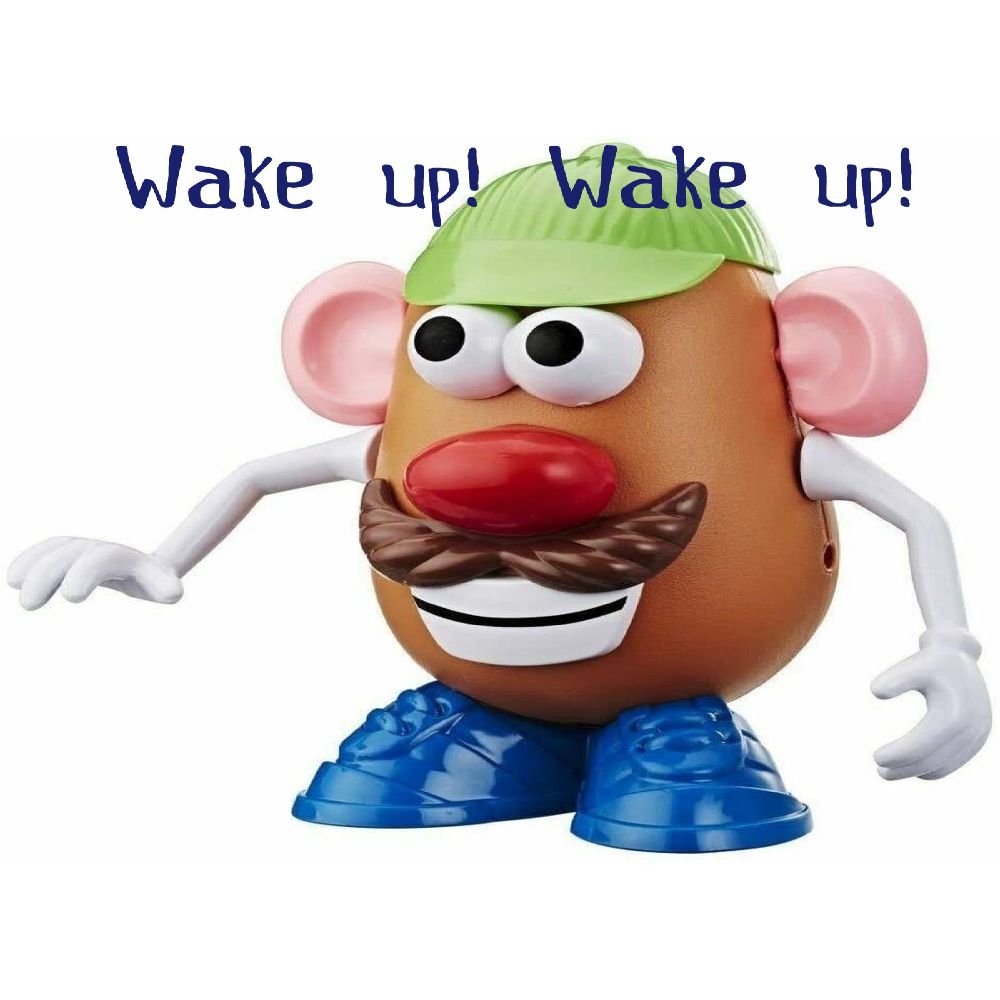
“Want to play Mr. Potato Head, Freddy?”
“No Dad, it’s just ‘Potato Head’, no gender.” It was Toby.
Hey, I didn’t say it would be easy and some of it seems plain silly but I did say I would try. Toby was simply trying to wake me up. And there are many other examples; I cannot for the life of me understand how it is that Popeye is a cartoonish relic of a male dominated sexist, paternalistic society who must be consigned to the dustbin of popular culture. He’s just a cartoon character, no more, no less.
So, if being woke requires me to abandon Popeye I guess I choose to not be as woke as some might require of me. There is a fine line between substance and silly. Nch! Nch. Nch! Nch! Nch! Besides, I’m still dealing with this whole ‘Potato Head’ thing.
But enough of me. I’m truly impressed if you’ve read this whole piece. I do go on! Being ‘woke’ is just modern vernacular, and vernacular changes with the seasons, other words adopted in their turn. Being ‘woke’ is just the word of the day. Being ‘awake’ though is far more. What matters is that it matters to you, that you care and that you are engaged in the issues of the day. If you don’t have lived experience, there is much to learn from observation, reading, studying, thinking and just being inquisitive.
In that, we can all play a part and help one another.


 Tony with a capital T
Leave a reply to tonywithacapitalt Cancel reply